2020 · Research
Eye-movement analysis of memory
Your eyes can give away what your memory knows, even before you commit to an answer. This project uses eye-tracking to show that memory can leave a signature in where you look, even when your final choice does not show it, and we try to answer the question of whether forgetting is just weak memory, or can it be an active, goal-driven process? More specifically, the primary objective is to utilize preferential viewing as a sensitive, indirect marker of relational memory to differentiate between incidental forgetting (failed Remember items) and successful intentional forgetting (Forget items). By doing so, we aim to move beyond "anti-forgetting" research (studying F-items that survived the cue) to analyze the mnemonic status of items successfully excluded from behavioral selection.
Definition of Preferential Viewing
Established by Hannula et al. (2007), preferential viewing refers to the phenomenon where eye movements are disproportionately drawn to test items originally studied in association with a specific scene, compared to equally familiar lures. This behavior is fundamentally linked to hippocampal activity, serving as a "veridical index" of relational memory that can emerge even in the absence of correct behavioral selection. This provides a methodological tension between indirect oculomotor markers and direct behavioral selection.
The study evaluates three primary theoretical mechanisms proposed to explain the Directed Forgetting effect.
| Account Name | Core Mechanism | Paradigm Association |
|---|---|---|
| Selective Rehearsal | A passive process where the F-cue leads to termination of rehearsal, while R-cues lead to more elaborate encoding and maintenance. | Item-method (Traditional) |
| Active Inhibition | An effortful process where executive control downregulates or suppresses mental representations during encoding and/or retrieval (Rummel et al., 2016). | Item-method (Modern) |
| Context-Change | Forgetting occurs because the internal context is intentionally shifted between lists, making the original context a poor retrieval cue. | List-method |
The experimental design utilized a relational memory task requiring nuanced distinctions of arbitrary associations between objects and scenes.
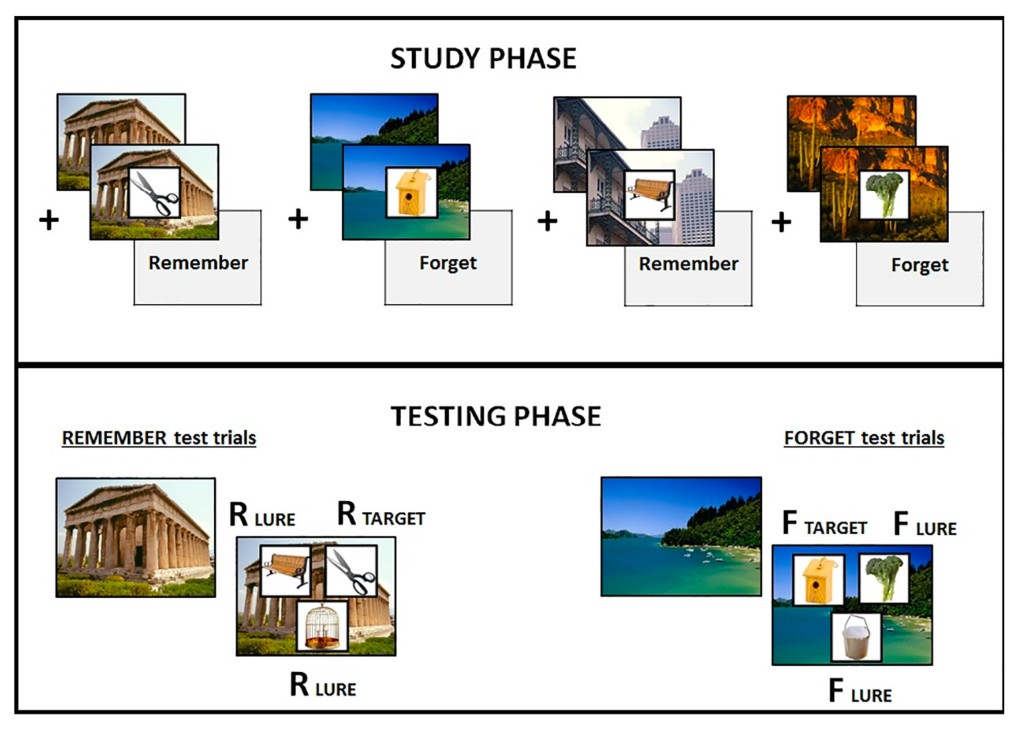
We found that a participant's cognitive goal—whether to remember or to forget—fundamentally dictates the expression of memory strength in oculomotor behavior. Results show that eye-tracking is uniquely sensitive to subtle mnemonic distinctions that remain invisible to standard recognition accuracy measures. Eye movements provide a veridical index of cognitive effort and mnemonic control, revealing that intentional forgetting is not a passive decay but an active reconfiguration of how targets and lures compete for attention during retrieval.